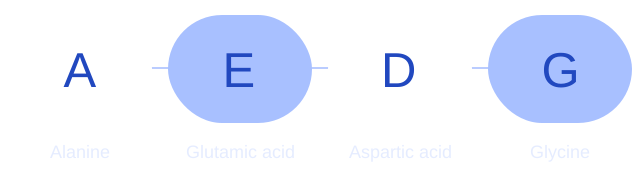
The four building blocks
Amino acids link together through peptide bonds. The order matters: the same building blocks arranged differently would describe a different molecule.
| Position | Amino acid | Three-letter code | Single-letter code |
|---|---|---|---|
| 1 | Alanine | Ala | A |
| 2 | Glutamic acid | Glu | E |
| 3 | Aspartic acid | Asp | D |
| 4 | Glycine | Gly | G |
Epitalon’s sequence is usually written from the amino terminus to the carboxyl terminus. In expanded notation, H-Ala-Glu-Asp-Gly-OH indicates the terminal groups as well as the residue order.
Chemical identifiers at a glance
The PubChem compound record provides a reference for identity. For the free form, commonly listed identifiers include CAS 307297-39-8 and PubChem CID 219042.
Epithalon is an alternative spelling of Epitalon. AEDG is a sequence abbreviation. These names help locate literature, but a product’s complete chemical description should still be checked.
Molecular weight describes the mass of a mole of molecules. It is not the amount in a vial, the concentration of a solution or a suggested human dose.
Why the chemical form matters
Epitalon may be supplied with counterions, residual water or formulation ingredients. A salt designation adds information about the material being supplied; it should not be silently dropped when comparing analytical documents.
A report that lists one form in its heading but another formula in its table deserves clarification. The name, formula, expected mass and reference standard should be consistent.
The FDA’s 2026 chemistry review distinguishes the free form from acetate and identifies inconsistencies in submitted product descriptions.
Structure does not establish clinical benefit
Knowing the sequence of Epitalon helps identify the molecule and design experiments. It does not reveal whether a finished product is sterile, whether a particular route delivers it effectively, or whether it improves a health outcome.
Likewise, “four naturally occurring amino acids” is not a safety guarantee. A molecule’s activity depends on its arrangement, exposure and biological context, not simply on the familiarity of its building blocks.
Reading a label alongside a report
When checking Epitalon, compare the product name and batch number first. Then check whether the certificate identifies the chemical form, analytical method and measured result. A mass spectrum and a chromatogram provide different kinds of information.
The guide to identity and purity testing explains why both are useful. Storage information should also apply to the exact formulation rather than to peptides as a broad category.
Reading one-letter and three-letter notation
The two sequence formats describe the same residue order. AEDG is compact, while Ala-Glu-Asp-Gly is easier to read when the amino acid names are unfamiliar. The letter E means glutamic acid; D means aspartic acid.
Sequence notation is not an ingredient list for making a product by mixing free amino acids. The residues must be linked in the specified order. A container holding four unlinked amino acids is not the same substance as Epitalon.
This distinction helps explain why knowing the components does not establish the behavior of the completed molecule. Chemical connectivity matters as much as the starting materials.
Formula, mass and concentration
A molecular formula states the numbers of each element in a molecule. It does not show every bond or describe a finished formulation. A structural formula and a sequence provide different information.
The average molecular weight is also different from an instrument’s observed mass-to-charge value. A mass spectrum may show charged species rather than a single peak at the neutral molecular weight. A qualified laboratory interprets the result in the context of its method.
Concentration adds another layer: it describes an amount within a volume. A formula cannot tell you the concentration of a solution, and a concentration cannot confirm that the intended molecule is present.
What a complete identity description should include
For Epitalon, a useful technical description should connect the name with the sequence and chemical form. The accompanying analytical report should identify the sample and use a suitable reference or method.
If two documents disagree, do not choose whichever number looks familiar. Ask whether one refers to the free peptide and another to a salt, or whether there is an actual labeling error. An unexplained inconsistency remains an inconsistency.
The same care applies to translated names and abbreviated labels. Similar wording is not sufficient to establish that two materials are interchangeable.
Why a short sequence still needs characterization
Only four residues may sound simple, but a synthesized material can still contain unwanted components. A sequence printed on a label describes the intended target, not proof of the contents.
Identity testing checks whether the material matches that target. Purity and quantity testing address separate aspects of the sample. The chemical reference is therefore a starting point for verification rather than the final quality assessment.
Where molecular identity fits
The introductory guide to this four-amino-acid peptide explains why Epitalon attracts interest. This technical reference addresses what it is; the separate studies and safety pages address what the evidence does and does not show.